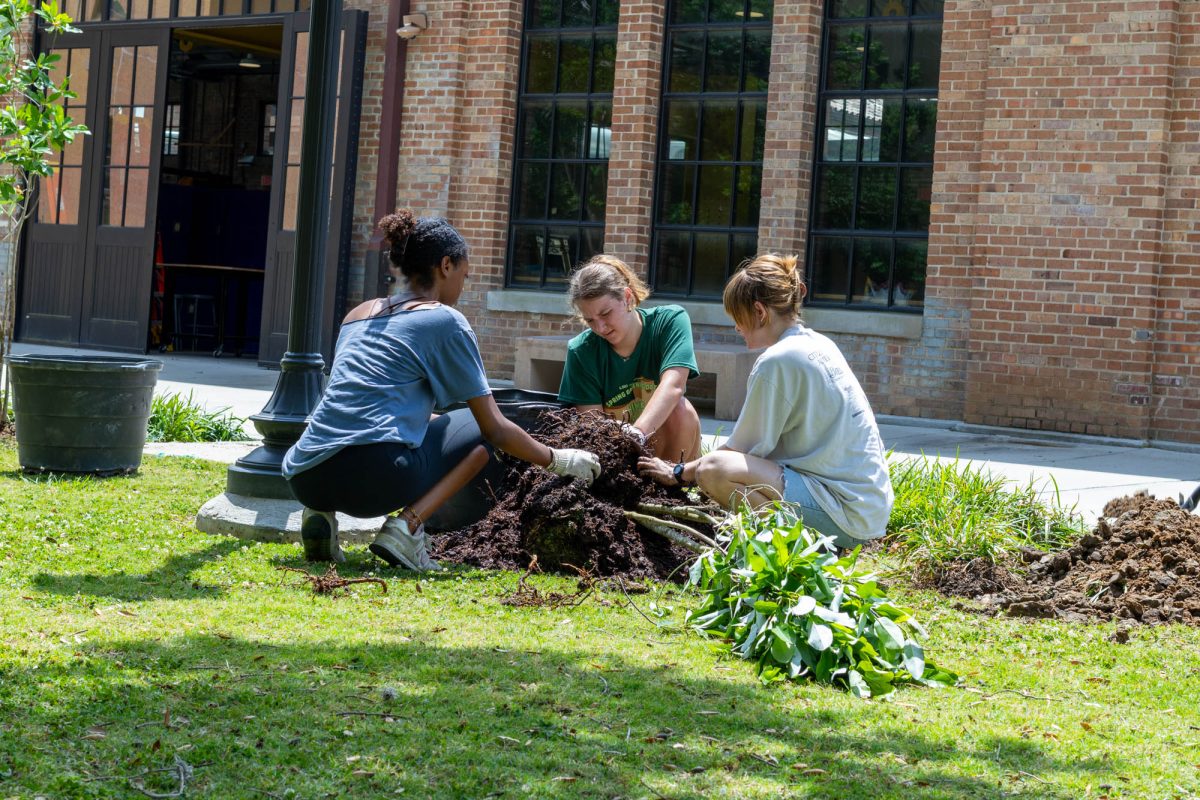
As Mardi Gras celebrations come to a close, organizations like LSU’s Geaux Green and Campus Sustainability encourage recycling and environmental sustainability.
Campus Sustainability is having a beads and throws drive for the third year in a row. Students can find collection bins in any of the residential halls or the Student Union up until March 5.
Caroline Clifford is a senior history major and a student worker for Campus Sustainability. She explained that her first year at LSU, she held onto beads and did not know where to dispose of them.
Clifford assumed many other students had the same problem. When she began working for Campus Sustainability, she asked if beads could be recycled anywhere. Her interest inspired Campus Sustainability to install collection bins on campus.
Lisa Mahoney, LSU’s Campus Sustainability manager, explained that her department gives all of the donated beads and throws to The Arc of Louisiana, an organization that empowers individuals with disabilities through employment and advocacy work.
Mahoney emphasized that students should donate all Mardi Gras paraphernalia — not just beads. She said that The Arc resells any usable items at its stores for discounted prices. Krewes buy them and reuse them.
“It’s repurposing beads and giving jobs to people that normally wouldn’t have an opportunity,” Mahoney said.
Mahoney also mentioned that Campus Sustainability partners with Glass Half Full, a sustainability-focused nonprofit based out of New Orleans. She said that organization tackles much of the recycling in New Orleans during Mardi Gras including beads, cans and bottles.
“They have recycle stations staged all across St. Charles. They recycle, and they’re doing it in real time,” Mahoney said. “You could go to the tent and see them sorting materials. Students can certainly get engaged with that. They actually do pay you to help out.”
The student organization Geaux Green also encouraged students to act sustainably this Mardi Gras season.
The club held an event Feb. 11 for students to make miniature floats out of repurposed materials.
Ian Frick is a coastal environmental sciences junior and the president of Geaux Green. He said they reused arts and crafts supplies that he bought for another event in the past. Members also brought cardboard and other materials they wanted to upcycle.
While they crafted floats, club members discussed sustainable initiatives different places in Louisiana are doing for Mardi Gras.
For example, Frick said Lafayette has a krewe that only does sustainable throws, whether it’s second-hand or wooden paraphernalia.
Geaux Green members expressed that although communities should still get more involved, they have noticed sustainable efforts increased this year.
Recycling and repurposing are not the only ways LSU students have attempted to make Mardi Gras more sustainable.
Naohiro Kato is a biological sciences professor, and he led the team of undergraduate and graduate students that created the PlantMe Beads last year.
Petroleum-based plastic beads take decades to degrade, and they release toxins. Kato’s team developed biodegradable beads containing seeds that can sprout into flowers.
Jennifer Cagnolatti is a biological sciences senior, and she was a part of the PlantMe Beads team.
Cagnolatti said her team used 3D printers and polylactic acid to produce the beads. She said they would stop the printing in the middle of the process, insert the seeds and then finish printing.
She said beads that students planted last year did successfully sprout flowers. The seeds also speed up the degradation process of the beads.
She added that her team was able to give some PlantMe Beads out to a few krewes this year to throw in parades. However, the team hopes to mass produce beads and give them out to even more krewes in the future.
“The whole reason behind this project was that we’re just trying to make Mardi Gras a little more sustainable,” Cagnolatti said. “We want people to enjoy Mardi Gras but also save the earth a little bit.”