One hundred ten miles from Baton Rouge, a Tulane student from Los Angeles went around Plaquemines Parish in hope of getting answers.
Lila Duarte spent 10 weeks in towns such as Port Sulfur and Belle Chase this summer to learn what these communities wanted regarding the Mid-Barataria Sediment Diversion Project, which was cancelled in July. The project targeted coastal restoration, aiming to divert sediment and freshwater from the Mississippi River to build land. A big part of its cancellation was community pushback in the southernmost part of the state.
Through LSU’s Office of Undergraduate Research and the Mississippi River Delta Transition Initiative “MissDelta,” Duarte was able to receive a project grant to pursue this research alongside other researchers from multiple fields. Duarte is a junior political economy and environmental studies major and was the only social scientist on her team this summer.
“Within the environmentalism movement or environmental justice, I’m really interested in working with communities,” Duarte said.
Duarte explained that her job was not to tell these communities what they needed, but to ask. Working alongside 20 researchers from LSU’s Coastal Ecosystem Design Studio and the five other people on her team, she started by doing a site analysis of the area and then asked the community what they thought of the issues.
While most acknowledged that flooding and land loss has been a major problem, they worried about the effect of such a huge project on the fishing industry, something they so heavily rely on. They wanted small scale restoration instead.
Distrust of the government also played a huge role in the process, as many communities in this part of the state felt as though they were left behind after Katrina. Duarte explained that this included mishandled evacuation plans and a delayed response to some of the areas most affected. While working, Duarte met plenty of people who said that their now ghost town used to be a lively community.
“With the help of my teammates, I developed this idea of institutional skepticism where it doesn’t matter, even if the government had this great idea, until you build trust with local stakeholders, they’re not going to listen to you, and the current model for coastal restoration does not include them,” Duarte said.
Until that change starts, she said there will continue to be opposition. Duarte’s solution is the theoretical framework of co-production. She said communities need to identify these issues themselves before having solutions forced on them. Then, by coming together to collect local ecological knowledge and think of solutions that also support community engagement, the process will go much more smoothly.
“Coming out of it, I feel like I know less. Realizing that things are not black and white at all in terms of coastal restoration because you need to look at a people’s livelihoods and ask where you draw the line,” Duarte said.
Duarte said that coming from a different state and being able to experience a research opportunity like this was at first a difficult space for her to navigate, but something she said she eventually thrived in.
LSU geology instructor and MissDelta Workforce Development Initiative team member Dominique Garello said the program not only builds scientific research skills, but a sense of community.
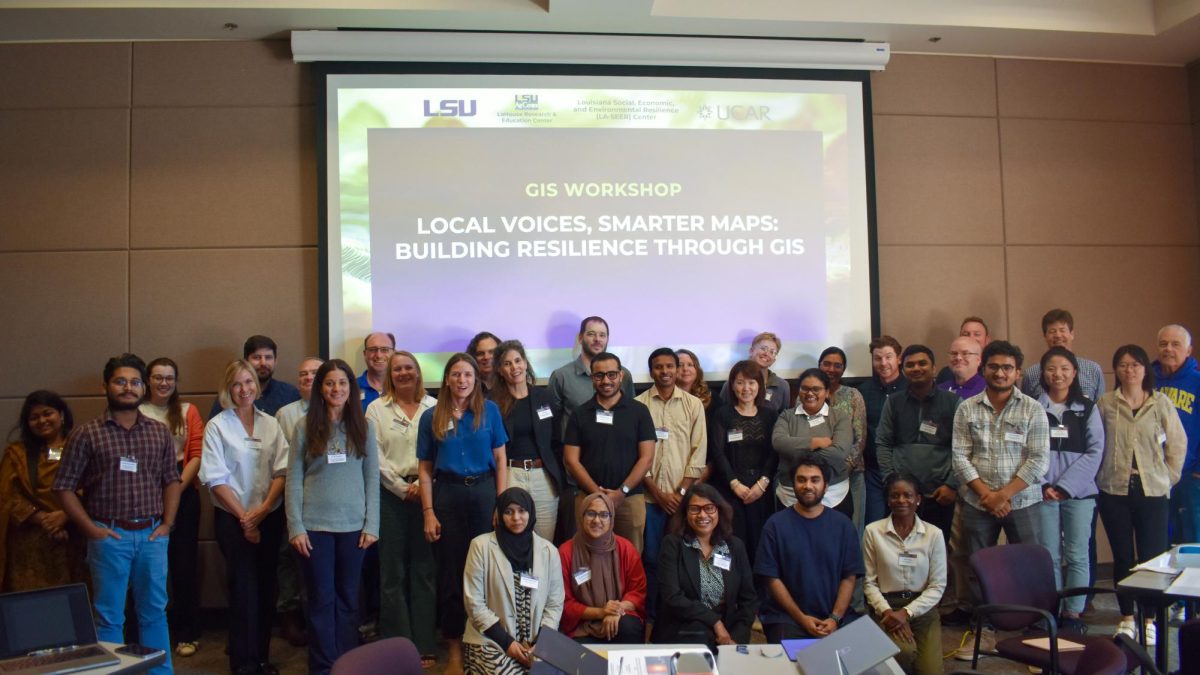
MissDelta focuses on advancing science and research so the public can forecast and understand the future of the Birdsfoot Delta. There are 14 institutes involved with MissDelta, most of them located in the Gulf South region, with LSU and Tulane being the two leads of the organization. The five-year research program is run through the Gulf Scholars Program of the National Academies of Science.
MissDelta’s main focus is researching why Louisiana is losing so much of its coast and the Mississippi River Delta so quickly. Garello explained that they are trying to gain a better understanding of where the sediment in the river is going.
The natural processes of the delta flooding have been impacted by the construction of dams and other structures to prevent these floods. While the prevention aspect might seem like a good idea, it also has the consequence of decreasing the amount of sediment that is put into the wetlands from the floodwater, which is why the coastline is shrinking.
“We’re losing our coastland, our wetlands and so one of the big pictures is understanding what’s going to happen in the future to the Mississippi River Delta,” Garello said.
An additional aspect of MissDelta is the Workforce Development Initiative that helps build and strengthen the coastal workforce. Part of that workforce is the research students they take on in the summer, as well as the educational programs they have for children in kindergarten through high school.
“We’re trying to broaden participation in coast research through various activities, providing resources, but also providing training, professional development and opportunities for hands-on experiential learning,” Garello said.
Another MissDelta student only had two weeks to prepare before heading west to Baton Rouge from the University of Southern Mississippi.
Ocean engineering student Wesley Rawlins got a call while on a hiking trip that LSU oceanography and coastal sciences professor Giulio Mariotti needed an undergraduate student to help with his research. He said that he was going to say ‘yes’ no matter what.
Rawlins joined Mariotti on an ongoing project where he focused on detecting hysteresis in the Mississippi River. Hysteresis is the difference between two things that are usually correlated, which in this case is the amount of discharge that comes down the river. The objective of the research is to classify flood-season into different phases using the data collected and compare it across different sites.
The four different sites were Belle Chasse, Natchez, St. Francisville and Tarbert Landing.
Instead of physical sites that have to be built, maintained and consistently checked up on in person, Rawlin’s research used satellite imagery to produce images to prove this can be done through remote sensing.
The results showed hysteresis detected at Belle Chasse and Tarbert Landing. The hysteresis confirmed through the results shows that early flood stages transport higher suspended sediment loads. The results also prove that at some locations, the same work that would usually be done in person can be done through the satellite imagery Rawlins was working with.
“The coolest and best part about this wasn’t necessarily the research, it was the ability to be at another school and do research and stuff with new people and meet new professors,” Rawlins said.
The OUR funds numerous projects throughout the summer and invites the students to also join them for their activities. OUR Director Sarah Ferstel said the workforce development aspect of MissDelta gets students to become researchers who will one day work on these big issues related to our coastal ecology as professionals. These students are housed at LSU with a stipend for food and other necessities.
“It’s supposed to be an intensive experience, meaning you work full time, and you’re trained and by then, you should have some research results that you could present at SURF or even another conference,” Ferstel said.
The Summer Undergraduate Research Forum was the last step of Duarte and Rawlin’s summer. The OUR-hosted conference allowed the two to present their findings alongside other undergraduate students from fields ranging from coastal sciences to engineering to humanities.
Just because their summer research is over doesn’t mean that their work is still done. To stay updated with the work that MissDelta does, check out their website here.