Baton Rouge, Louisiana is situated on the Mississippi River, about 230 miles from the Gulf of Mexico. A team of professors and postdoctoral scholars at LSU has closed that distance by discovering a way to track hypoxia in the Gulf quicker and more efficiently.
Hypoxia is when oxygen levels are low or none, creating a “dead zone” that negatively affects marine life. The hypoxic zone in the Gulf of Mexico is 4,000 square miles and is caused by excess nutrients.
The estimated direct economic impact from hypoxia in the Gulf of Mexico is $80 million per year.
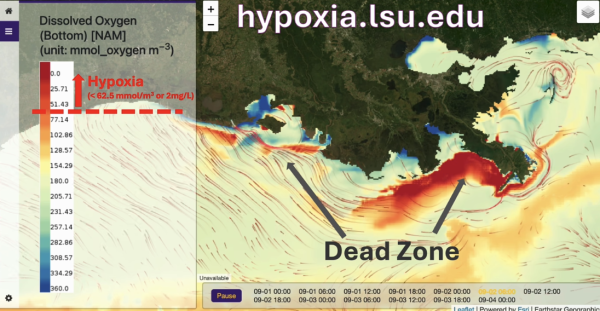
George Xue, an oceanography and coastal sciences professor, Supratik Mukhopadhyay, an environmental science professor, Yanda Ou, a postdoctoral researcher and other team members created a new model using artificial intelligence tools to make daily hypoxia forecasts.
“The hypoxia condition is very serious every summer in coastal Louisiana, but we do not have enough observations,” Ou said.
Ou said the Gulf’s hypoxia was usually studied at a seasonal scale via observations or at a daily scale using mechanistic models. Those models were expensive and hard to maintain without an HPC system. By incorporating AI into the numerical model, Ou said they can forecast hypoxia significantly faster.
The concept is to train an AI model using numerical output and then compare the predicted hypoxia area against the observation. Ou said that more observations and mechanistic model outputs are required to further enhance the AI model’s predictive performance.
“The beauty of AI is the high computational efficiency, that we can try a lot of data and then do an ensemble of the output that can also help to increase the accuracy and kind of help the research see what is the uncertainty of the prediction,” Ou said.
Xue is Ou’s supervisor and helps secure the funding for his research. This recent finding is not the first of Ou’s, the post-doctoral scholar has spent years researching ways to better understand his work.
The numerical model used a process similar to weather forecasting. Xue explained that with an ocean forecaster, they solve equations for the fluid dynamics in the ocean region. He used the example of tracking the wind and how it might affect the growth of a certain plant.
Even though the new AI model still relies on numerical models to generate data, it computes results much faster.
“We need to understand what caused this dead zone and how we can better forecast it,” Xue said.
The dead zones caused by hypoxia threaten various types of marine life. Xue said that in all ecosystems, every organism has its niche or special role. If an area of hypoxia lasts for too long or happens too frequently, different species can start dwindling in numbers, therefore affecting others that rely on them.
Not only does this affect the creatures living in the ocean, but also the industries that rely on them. Ou said that forecasting hypoxia allows fishermen a better understanding of what is going on with what they are catching and what to expect. Higher hypoxia means fewer fish to catch leading to higher seafood prices. Ou said that hypoxia affects everyone.
Algal blooms are another consequence of hypoxia and are toxic to humans.
“There will be a cascade of consequences,” Xue said.
Mukhopadhyay said there are two causes for hypoxia. The first is stratification, which is when there is a difference in density because of salt water and fresh water mixing. He used the example of when a river meets a sea or ocean, the two mix with the heavier going down and the lighter going up.
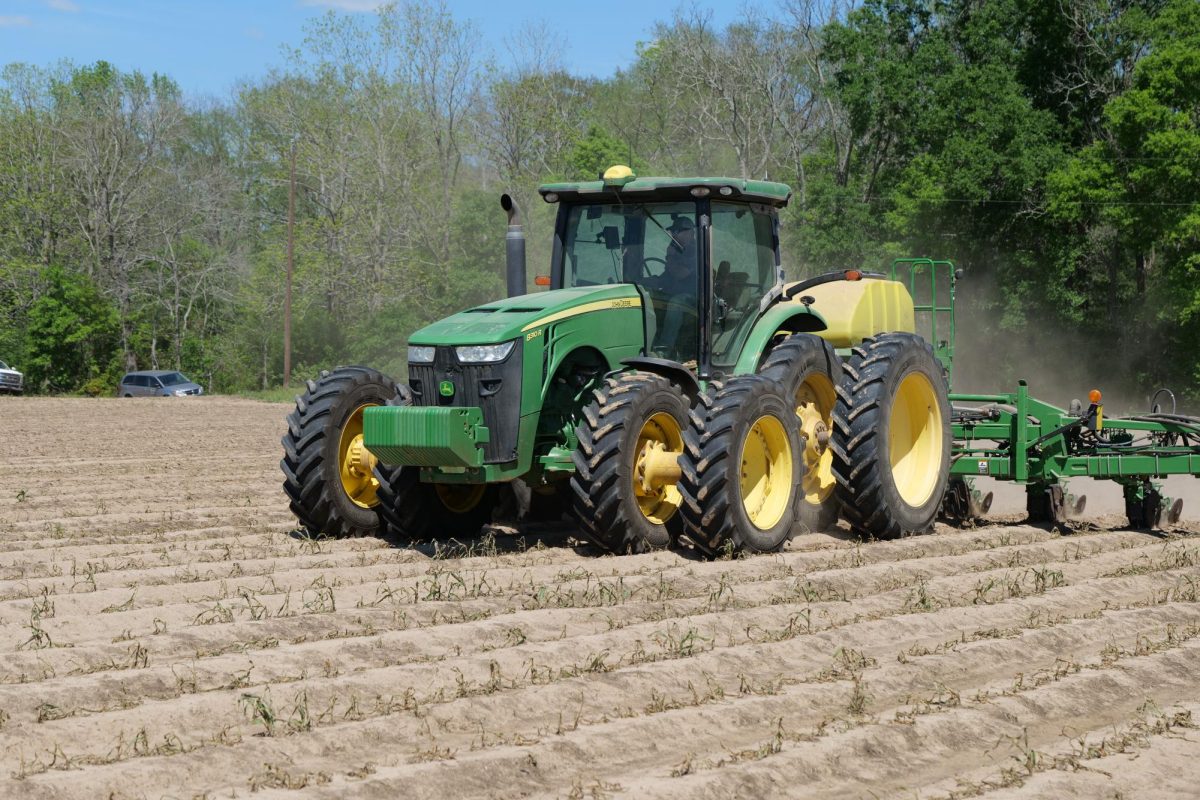
The second cause is nutrient pollution. This is human-induced, where nitrogen and phosphorus form a layer on the water. It comes from agricultural runoff, sewage wastewater and other man-made waste.
By predicting hypoxia before it happens, Mukhopadhyay said they can work on improving solutions to decrease it. One of those solutions is encouraging repeat nutrient pollutant offenders to dispose of harmful waste more sustainably.
“For AI for science to progress, we need mechanistic models that are transparent indeed of open models because science is all about transparency,” Mukhopadhyay said.
The team’s next steps are working on increasing the resolution of the model. The current resolution is about five kilometers, but they want to expand to one kilo for a better forecast.
They also plan on collaborating with more stakeholders, including federal agencies like NOAA to better serve the public.
“This work would not be possible without the talents in my group,” Xue said. “We need to make sure the talents are retained in Louisiana.”
To see daily hypoxia updates, see their model here.