By this time next week, LSU will have named a permanent president, ending an almost six-month long process that began when former President William Tate IV took the same job at Rutgers University in May.
Since then, LSU has been in a position of relative uncertainty and has been unable to make major personnel decisions without a leader. The university has openings at several key administrative positions, most notably the provost, after a string of high-profile resignations in the spring.
Then, of course, there’s the head coach of the football team. After the university fired coach Brian Kelly, many are eager to select a replacement, but LSU needs a president to guide that process.
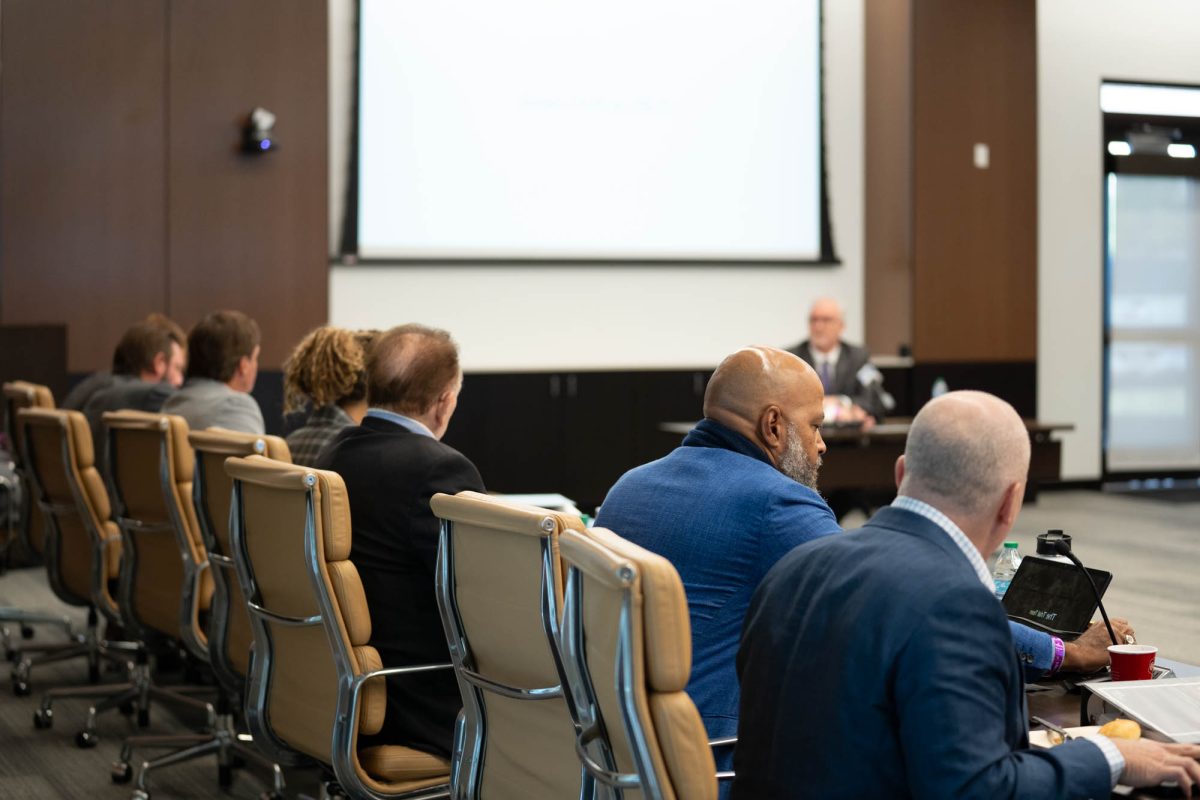
The Board of Supervisors will officially interview finalists and vote to select one president on Tuesday.
Here’s where the process stands, broken down.
It’s down to three finalists
The three finalists selected by the presidential search committee, ending their involvement in the process, are Alabama Provost and Executive Vice President James Dalton, former University of Arizona President Robert Robbins and McNeese State University President Wade Rousse.
Dalton has held his position at Alabama since 2020, and his background is in pharmaceutical sciences. In his interview, Dalton said he wanted to make his time as the president “student-centric” by prioritizing workforce development, hiring strong faculty and increasing academic and research support.
Robbins was the president at Arizona from 2017 to 2024, which represents tangible experience working at a tier one research university. He emphasized during his interview the lengths he goes to connect with students, including inviting them to his home and even handing out his phone number. He resigned from Arizona while the school was dealing with a $177 million financial deficit, reportedly due to an accounting error. Robbins said Wednesday there was no foul play in that and the university was at no risk of defaulting.
Rousse took his position at McNeese in 2024 after working there at his alma mater since 2019 in various administrative roles. Under Rousse, McNeese has reversed a 14-year enrollment decline and in September announced its highest enrollment increase in 22 years. Rousse fought off criticism Wednesday that he doesn’t have a research background or experience at a high-level university and said he knows his biggest challenge as LSU president would be gaining the trust of the faculty.
Read more about the three here.
Stakeholders will have a chance to meet and question the finalists
Each finalist will have a full day set aside for them to hold public forums and meetings with stakeholder groups. Each finalist will be available to publicly take questions from students, faculty and staff. They’ll also meet privately with campus leadership, student leaders and athletics administration.
That process will start immediately. Dalton was assigned Thursday, Robbins Friday and Rousse Monday.
View the schedule the candidates will follow on their assigned day here.
One finalist was introduced late in the process
Dalton was not on a list of 30 candidates that expressed interest in the LSU opening the search committee reviewed Oct. 23, nor was he in the group of six the committee formally asked to apply from that pool. Instead, he was introduced Wednesday in an agenda item named “consideration of additional applications.” Some members of the committee seemed unaware Dalton was going to be interviewed.
Dalton said he had a “delay in applying” during his interview. Board of Supervisors Chair Scott Ballard said Dalton had applied in the last few days but couldn’t recall the exact day. Dalton had already traveled to Baton Rouge for the interview.
The same scenario happened in 2021, the last time the university had a presidential opening; LSU made a late addition to the group it said it intended on interviewing. That addition was Tate, who ended up being selected for the position.
One finalist is considered the one favored by Gov. Jeff Landry
Rousse is considered in some circles the candidate that best aligns with what Gov. Jeff Landry wants. Rousse received an endorsement very early in the search process from Board of Supervisors Vice Chair Lee Mallett, who’s donated thousands of dollars to Landry, according to the Campaign Finance Portal.
Landry, now in the second year of his term, has an increasingly large influence on LSU happenings, so it’s expected his opinion will carry weight.
He reportedly played an active role in the decision to fire Kelly, even hosting discussions between leaders and donors at the Governor’s Mansion. He bashed Athletic Director Scott Woodward on Wednesday and said he wasn’t going to be the one selecting the new football coach. On Monday, he called for LSU to erect a statue of late conservative activist Charlie Kirk on campus to “protect free speech.”
Landry also publicly lobbied for a live tiger to return to LSU game day tradition in 2024, and he got his wish for one game versus Alabama when a tiger named Omar, transported from Florida, was wheeled on the field.
LSU’s interim president wasn’t voted into the final three
LSU Interim President Matt Lee interviewed Wednesday but wasn’t selected as a finalist, receiving nine of 20 votes on the committee. Lee had significant faculty support as a candidate, according to letters from the community that the committee reviewed Wednesday.
Lee was previously the vice president of agriculture and dean of the College of Agriculture. He’s worked at LSU since 2004.
The most controversial event of Lee’s tenure as interim president was the school’s decision to close the Unity Field tailgating area in a stated effort to increase game day security. Lee said the university’s investigation traced two recent game day shootings to the area.
Many students were disappointed by the decision, perceiving it as racially targeted as Unity Field is the area where most of LSU’s Black Greek organizations host tailgates. Lee said on Wednesday that he regretted not consulting student leaders on that decision.