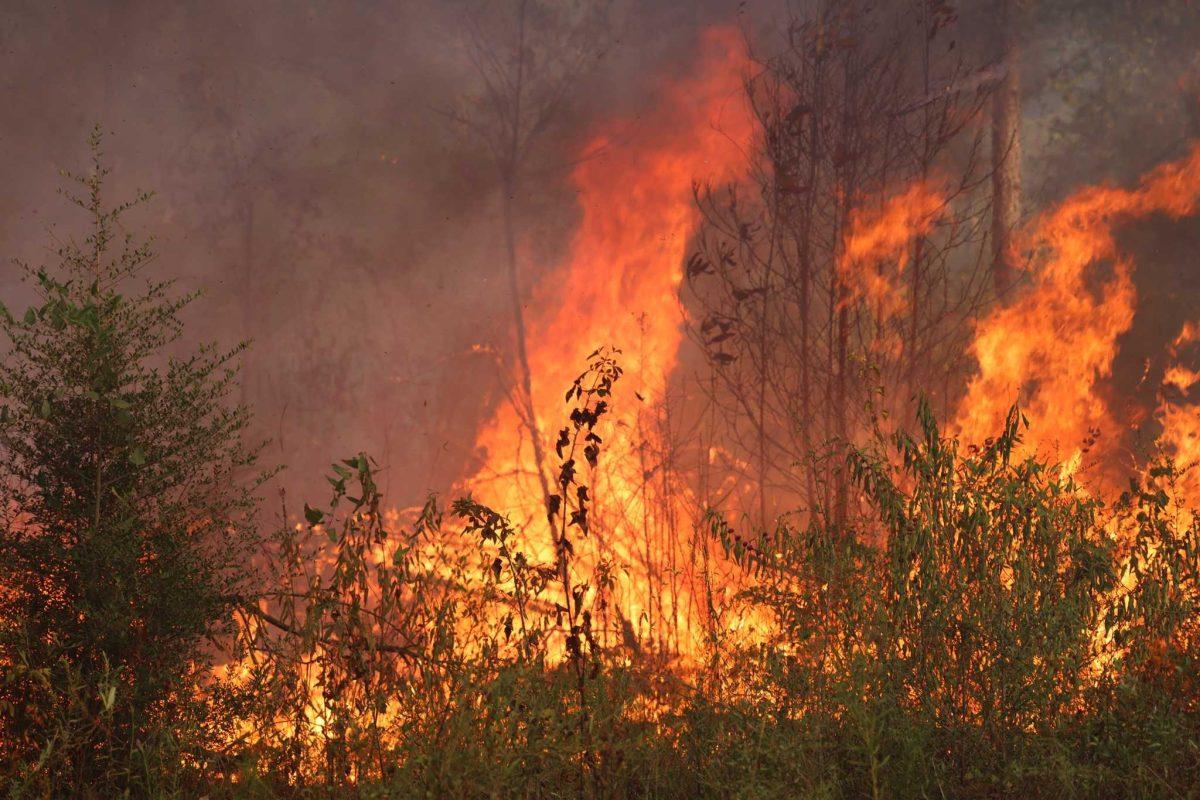
A group of researchers at LSU have developed a disaster management instrument called “DeepFire,” a tool that uses artificial intelligence to predict when and where wildfires can start before ignition.
DeepFire is an AI-based system that can predict wildfires in particular regions so that emergency managers can allocate resources ahead of time to prevent disasters.
The project first started in 2019 when undergraduate researchers pitched this idea to Supratik Mukhopadhyay, a professor from the Department of Environmental Science.
Mukhopadhyay said that DeepFire is unique in that it will be the first tool that can detect wildfires before they start.
“The way you do it currently, it’s all of a sudden — destructive wildfires don’t inform you before it starts,” Mukhopadhyay said. “The fire department is taken, with its limited resources, by surprise.”
The research helps mean helping disaster managers triage the most important fires in different timescales, such as four, seven, 15, 28 and 35 days. According to Mukhopadhyay, DeepFire’s predictions are accurate about 90% of the time.
“If I say that there’ll be [a fire] in 15 days at a particular place, then there is a 90% chance that it will happen, establishing the team of responders to put their resources at the right place and be ready,” Mukhopadhyay said.
The team has emerged as a global leader in wildfire innovations and was named a finalist for the XPRIZE Wildfire competition held in Australia in an attempt to win $11 million. The team of four has already won $85,000.
Mukhopadhyay works with three other researchers: Rubayet bin Mostafitz, an assistant research professor with the LSU AgCenter; Saiful Sajol, a doctoral student and graduate research assistant for the Department of Environmental Science and Thomas Douthat, an assistant professor of environmental science.
Mukhopadhyay said that he does not think other teams have the same communication framework and prediction detection speed that they have, but sometimes they have a slower satellite refresh rate.
He said one day the predictions might take half an hour, but it might take longer other days depending on variables such as cloud coverage and interference.
Another issue the team faces is that different climates require different types of prevention and response.
While Australia has an arid and dry climate with less nutrient dense soil, places like Alberta, Canada or California — two places in North America where DeepFire has been tested–the soil has more nutrients and requires a different type of response.
The team is hoping to expand its research to other types of natural hazards, like hurricanes, flooding, tornadoes, droughts and other disasters that require assistance from emergency managers.
Bin Mostafiz used Hurricane Katrina and the historic Baton Rouge floods in 2016 as examples of cases where a prediction tool would have been useful.
“We are trying to use the same technology for different hazards,” Bin Mostafiz said. “We are applying for a proposal from the National Science Foundation to study not only the detection system but also how people behave in evacuation-based disasters.”